
How to Choose the Right Plywood Board for Your Home
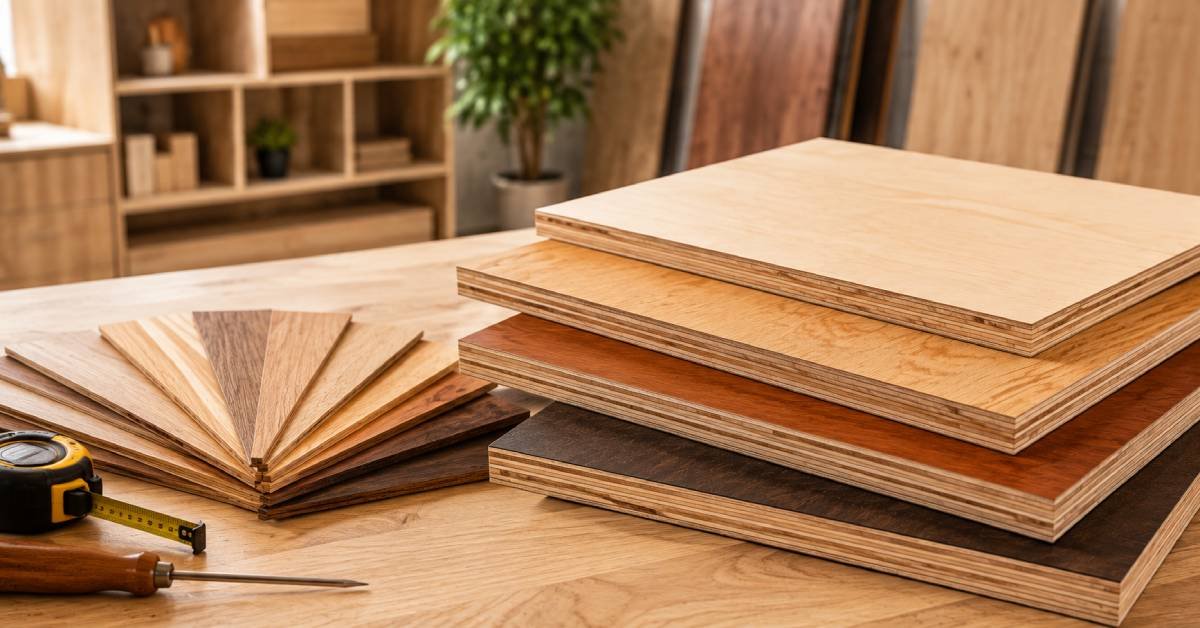
Knowing how to choose the right plywood board will help you when you’re looking for high quality and performance on a budget.
It's relatively simple to decide that you want plywood for your house until you begin looking at different grades, ply, thickness, finishes, and of course, the price.
The appropriate choice of plywood can make your furniture strong and durable as well as resistant to everyday wear. Whereas the incorrect selection could lead to your furniture warping or swelling after some time or cracking over usage.
This guide covers the key factors to consider before making your choice of plywood for home interiors.
Why Choosing the Right Plywood Matters
What if your stylish new modular kitchen shutter doors begin to bloat after water contact-not because of design or construction errors, but because of the plywood under them? Plywood is the backbone of most interior furnishings.
Its strength, resistance to swelling due to moisture, dimensional accuracy, and the capacity for holding screws all contribute to the endurance of the article.
Which plywood for home interiors you should use for the cabinet is determined by its application and the place where it is located: a board that will be perfect for a bedroom or an office can cause a big problem in a kitchen or a restroom cabinet.
How to Choose the Right Plywood Board
Before buying, consider the following factors and learn how to choose the right plywood board.
1. Understand the Different Types of Plywood
Plywood is available in different forms and ratings used for different purposes. The best quality plywood sheets are:
MR plywood:
These are mainly for wooden furniture in dry areas of the house such as the bedroom, living room, and study room. Be mindful, it’s just moisture resistant and not fully waterproof.
BWR plywood:
These are comparatively less sensitive to moisture as compared to MR plywoods. Can be used where furniture may experience a moderate level of moisture exposure.
BWP or marine-grade plywood:
Boiling Waterproof plywood provides higher water resistance and is generally preferred for demanding applications such as kitchen cabinets, sink units, and areas exposed to frequent moisture.
Marine plywood is a premium category and should be selected according to the manufacturer's specifications rather than assuming every waterproof-looking board is marine grade.
2. Choose the Right Thickness
Thickness affects the strength and stability of plywood. The right thickness depends on the furniture and the load it needs to carry.
Common thicknesses include 6 mm, 9 mm, 12 mm, 16 mm, 18 mm, and 25 mm, although availability varies.
For example:
|
Application |
Common Thickness Range |
|
Cabinet backs |
6–9 mm |
|
Drawer bottoms |
6–9 mm |
|
Furniture panels |
12–18 mm |
|
Wardrobes |
16–18 mm |
|
Kitchen cabinets |
16–18 mm |
|
Heavy-duty furniture |
18–25 mm |
This is just a basic guide. It may vary due to the nature of your construction, the size, and anticipated load, and will be stated by your designer or joiner.
3. Check the Plywood Grade
The grade of the plywood depends on the type of wood veneers, bond, core construction and how the whole product is constructed.
Ideally, check that the grade you choose is a good, even, thick board, with a smooth surface and strongly bonded plies, and minimal defects. If you have a certification system, you will also have increased confidence when products are supplied with specified grades.
Do not judge plywood only by its appearance. A smooth surface does not necessarily mean the board has superior structural performance.
4. Consider the Room Where It Will Be Used
The location of the furniture should guide your plywood selection.
In a Bedroom and living room, many uses can be adequately fulfilled by MR plywood as they do not experience considerable moisture exposure.
In a kitchen, BWR or BWP plywood might be ideal for most usages especially for cabinets in proximity to the sink and its associated exposure to water.
In a bathroom, select a plywood made for high-moisture situations and additionally ensure that edges and joints are adequately sealed. Constant accumulation in a waterproof ply, with moisture penetrating through its edges, will damage it eventually.
5. Look at Core Construction
Plywood is made by bonding multiple layers of wood veneer together, usually with the grain direction alternating between layers. The quality and arrangement of these layers influence the board's strength and stability.
When buying plywood, inspect the edges. Look for:
- Uniformly arranged layers
- Minimal gaps or voids
- Consistent thickness
- Good bonding between veneers
- No obvious delamination
An internally spaced board may be less robust and might not maintain the integrity of fixings to the same degree as a high-quality product.
6. Check Screw-Holding Capacity
Furniture is constructed and fitted using furniture hardware including screws, hinges, drawer runners, handles and more. Plywood’s sturdy core material ensures an excellent screw-holding capability.
This is especially relevant when constructing large furniture units such as wardrobes, fitted kitchens, beds and any items mounted on the wall as these structures and fittings are under a consistent load and are subjected to movement.
Board that breaks, crumbles and displays large internal spaces after drilling to receive fixings.
7. Consider Termite and Borer Resistance
Depending on where you live, wood-based materials are susceptible to termites and wood-boring insects.
The appropriate application method can minimise their attraction but for a robust and lasting finish, especially when construction is exposed to elements in or outside the home, investigate plywood which has been treated to offer resistance.
The right method of fixing and construction will offer additional protection from pest penetration.
8. Compare Brands and Certifications
After you have ascertained the type of board and its dimensions, then compare brand with brand and it is advisable to look towards quality at the right price tag instead of just the lowest; not to be said that the cheapest are necessarily bad.
Look out for the brand on the label of the board and investigate as far as product information including:
- Plywood grade
- Applicable standards
- Thickness
- Manufacturer details
- Certification or quality marks
- Warranty, if offered
- Recommended applications
A trustworthy seller should also be able to provide the best quality plywood sheets.
9. Inspect the Board Before Buying
If buying plywood in person, take a moment to look at some of the sheets. Are they reasonably flat and uniform on the surface?
Inspect edges for gaps between layers or delamination. Is the wood bowed or warped?
Try to ensure the sheet thickness is consistent from one side to the other. It can also be useful to note if there is a strong odd odor to the wood or if the board looks like it has water damage. If most sheets in a batch are damaged the supplier might even be willing to talk to you about the defect.
FAQs
Q1. How to choose the right plywood board in India?
Consider the room, moisture exposure, required thickness, plywood grade, core quality, certifications, and budget. For kitchens and moisture-prone areas, choose a water-resistant or waterproof grade suited to the application.
Q2. What are the types of plywood used in interior?
Commonly used interior woods are MR, BWR, BWP, and Marine plywood.
Q3. What type of plywood is waterproof?
The BWP grade is ideally made to offer the best resistance to water. Kitchen and bath interior plywood can be designed using this type.
Q4. What type of plywood is best for furniture?
For humid environments, it is better to use BWP or BWR for furniture. And for dry weather places, MR plywood is also the best choice of wood for furniture.
Q5. What is the most popular plywood standard size in India?
Generally it will be 8x4 feet. Though available with manufacturers in different sizes too.
Conclusion
The process of learning how to choose the right plywood board boils down to this one principle: to choose the appropriate board for the appropriate task. A bedroom wardrobe, a kitchen cabinet, a bathroom vanity and even a super solid bed can’t necessarily be built out of the same panel product.
Explore plywood collection based on how and where you intend to use the sheet and then analyze the environment and build specifications such as moisture level, board thickness, manufacturing quality, applicable standards, life cycle, and of course, cost.
But never sacrifice the structural integrity and construction quality just to save some money in the outset.
Learn More: How Decorative Plywood Enhances Interior Design and Furniture Appeal


