
Plywood Grades Explained: Which One Is Best for Home Interiors?
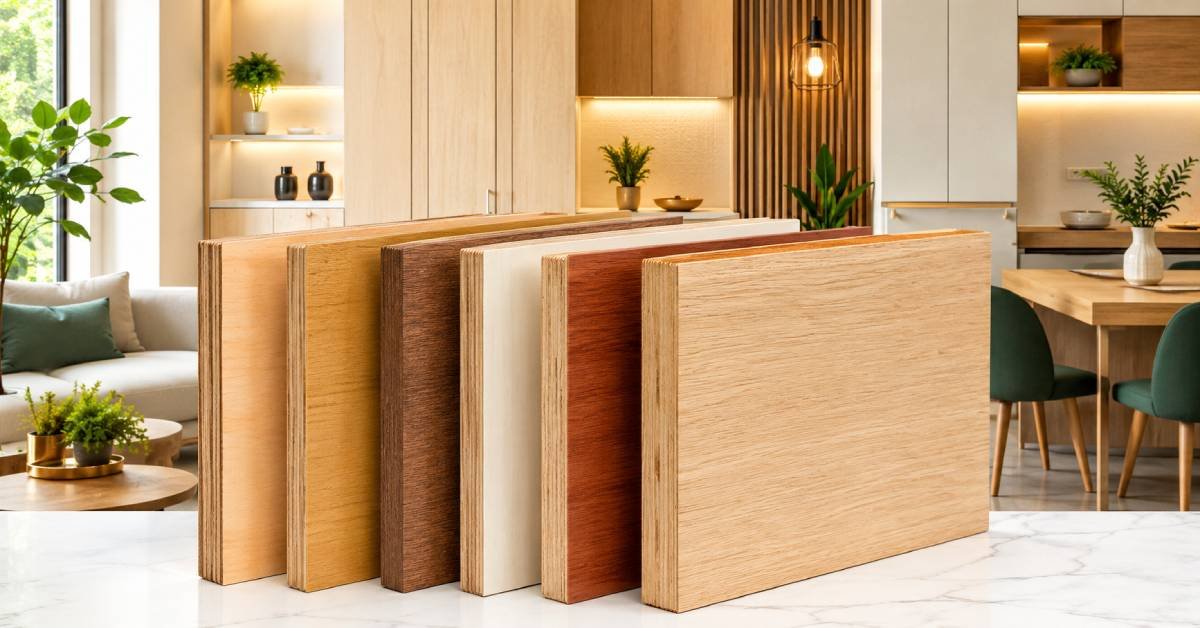
Imagine you are standing in a plywood showroom with your interior designer. There are stacks of boards everywhere, each carrying words that sound reassuring: MR, BWR, BWP, Gold, Platinum, Marine.
You know you need plywood. You know it will sit behind your beautiful laminates, veneers and paint finishes for years. But suddenly, one simple question becomes surprisingly difficult:
Which plywood grade should you actually buy?
The answer isn’t simply “the most expensive one.”
Different plywood grades are designed for different levels of moisture exposure, durability and usage. The right choice for a bedroom wardrobe may be unnecessary for a kitchen, while the wrong choice for a sink cabinet can become an expensive mistake later.
So before you choose a plywood board for your home interiors, let’s break it down in a simple, practical way.
What Are Plywood Grades?
Plywood comes into being from the pressing together of several very thin veneers of wood that overlap, each with the grain rotated 90 degrees compared to the previous. These alternating perpendicular grain orientation laminations create plywood panels that are stronger than a board of solid wood, more dimensionally stable and resist warping.
But not all plywood is made for the same environment.
That’s where plywood grades come in.
In India, the most commonly used types of plywood grades are:
- MR – Moisture Resistant
- BWR – Boiling Water Resistant
- BWP – Boiling Water Proof
These grades indicate how well plywood can handle moisture and water exposure. MR is suitable for dry interiors, BWR handles moderate humidity, and BWP is designed for high-moisture or wet zones.
Think of it like footwear: you don’t wear rain boots to a wedding just because they are “stronger.” You choose based on the situation.
What Is MR Grade Plywood?
Let’s start with the most commonly used option.
MR grade plywood stands for Moisture Resistant plywood. It is designed for indoor furniture where exposure to water is minimal.
If you are making a bedroom wardrobe, study table, or living room cabinet, MR plywood is often sufficient.
However, one important point must be clear:
MR does NOT mean waterproof.
It can handle humidity in the air, but not direct or repeated water contact.
This is why MR plywood is widely used in dry areas but avoided in kitchens and bathrooms.
MR plywood is generally associated with IS 303 standards for interior applications.
Where is MR plywood best used?
- Bedroom wardrobes
- Living room furniture
- TV units
- Bookshelves
- Study tables
- Wall panelling
- Dry storage units
- Decorative furniture
The biggest advantage is cost efficiency—you are not paying extra for water resistance you don’t need.
Gold MR Plywood and Platinum MR Plywood: What Do They Mean?
While exploring the market, you may hear terms like Gold MR Plywood or Platinum MR Plywood.
These are not official plywood grades. Instead, they are brand-level marketing names used by manufacturers to position their products.
So, “Platinum” does not automatically mean better than MR or closer to BWP.
Instead of focusing on the name, always check:
- Actual plywood grade (MR, BWR, BWP)
- IS standard compliance
- Core quality and construction
- Warranty offered
- Brand reputation
A premium MR product may offer better durability, termite resistance, or finish quality—but it is still MR at its core.
A simple rule to remember:
Don’t buy the name. Buy the specification.
BWR Grade Plywood: The Middle Ground
Places with higher humidity are where BWR grade plywood becomes useful.
BWR stands for Boiling Water Resistant. It offers better moisture resistance than MR and is commonly used in semi-humid areas.
Where can you use BWR plywood?
- Kitchen cabinets (dry zones)
- Utility areas
- Semi-humid interiors
- Furniture near water sources (but not direct contact)
- Homes in coastal or humid regions
BWR is often considered a balanced option—better protection than MR without the higher cost of BWP.
BWP Grade Plywood: Built for Wet Zones
Some areas in a home deal with water constantly.
This is where BWP grade plywood becomes essential.
BWP stands for Boiling Water Proof and is associated with IS 710 plywood. It is designed for maximum resistance to water exposure and long-term durability in wet conditions.
Where should you use BWP plywood?
- Under-sink kitchen cabinets
- Bathroom vanities
- Wet kitchen zones
- Areas with frequent water exposure
- High-humidity environments
- Long-term moisture-prone furniture
Yes, BWP is more expensive—but it prevents costly repairs and replacements later.
In wet zones, it is not an upgrade. It is a necessity.
Plywood Types and Grades: Simple Comparison
Here’s a quick breakdown of plywood types and grades:
|
Plywood Grade |
Meaning |
Moisture Resistance |
Best Use |
|
MR |
Moisture Resistant |
Low |
Bedrooms, living rooms |
|
BWR |
Boiling Water Resistant |
Medium |
Kitchens, utility areas |
|
BWP |
Boiling Water Proof |
High |
Wet zones, bathrooms |
The key idea is simple: match the grade to the environment, not the room name.
A kitchen has both dry and wet zones. A bathroom has constant moisture exposure. Smart selection matters more than uniform selection.
MR Grade Plywood Price: Is Cheaper Always Better?
When comparing MR grade plywood price, it is easy to get tempted by lower-cost options.
But plywood is not just a surface material—it is the structural backbone of your furniture.
Even if hidden behind laminates, it determines:
- Strength
- Durability
- Screw holding capacity
- Resistance to warping
MR plywood is cheaper than BWR and BWP, which is why it is widely used in dry furniture.
However, price should never be the only factor. Always evaluate:
- Thickness consistency
- Veneer quality
- Core construction
- Adhesive quality
- IS certification
- Termite resistance
- Brand warranty
Two MR sheets can behave very differently in real use.
Does Thicker Plywood Mean Better Quality?
Not always.
A common misconception is that thicker plywood automatically means better quality.
But quality depends on:
- Core uniformity
- Bonding strength
- Veneer quality
- Manufacturing process
A poorly made 18 mm sheet can be weaker than a well-made 12 mm sheet.
Thickness is about strength. Grade is about moisture resistance. Both serve different purposes.
How to Choose the Right Plywood Board for Your Home
Instead of choosing one type for the entire house, divide your home into zones:
Bedroom
MR plywood is usually sufficient for wardrobes and furniture in dry conditions.
Living Room
MR plywood works well for TV units, shelves, and cabinets.
Kitchen
Use BWR for dry areas and BWP for wet zones like under-sink cabinets.
Bathroom
Always prefer BWP or equivalent high-moisture-resistant plywood.
What Should You Check Before Buying Plywood?
Before finalizing any plywood board, ask these questions:
- What is the actual grade—MR, BWR, or BWP?
- Does it follow IS 303 or IS 710 standards?
- Where will it be used in my home?
- Is the core construction uniform?
- Is thickness consistent across sheets?
Common Mistakes People Make
Using BWP Everywhere
Unnecessary cost increase without real benefit in dry areas.
Using MR in Wet Areas
Leads to swelling, damage, and early replacement.
Confusing Brand Names with Grades
Gold or Platinum does not define performance.
Ignoring Core Quality
Surface finish hides internal quality issues.
FAQ: Plywood Grades Explained
1. What are the main plywood grades?
MR, BWR, and BWP are the most common grades used in home interiors.
2. What is MR grade plywood used for?
It is used for dry indoor furniture like wardrobes, shelves, and TV units.
3. Is BWP plywood waterproof?
BWP is highly water-resistant and suitable for wet zones, but no plywood is completely “waterproof” in extreme conditions.
4. What is the difference between MR and BWR plywood?
MR is for dry areas, while BWR offers better resistance to moisture and is suitable for kitchens and humid spaces.
5. How do I choose the right plywood grade?
Match the grade to the moisture level of the area where the furniture will be used.
Final Thoughts
The trick to buying plywood is not to spend more on each piece but to figure out where to use each one! MR plywood is best suited for dry areas, BWR plywood deals with the balance between cost and moisture resistance and BWP plywood offers great durability in wet areas.
So when you see titles like Platinum MR Plywood, Gold MR Plywood, etc, understand that the worth of each of them is defined by the specification.
A well-planned home doesn’t use the best plywood everywhere.
It uses the right plywood in the right place.


