
Plywood Thickness Guide: Standard Sizes, Uses & How to Choose
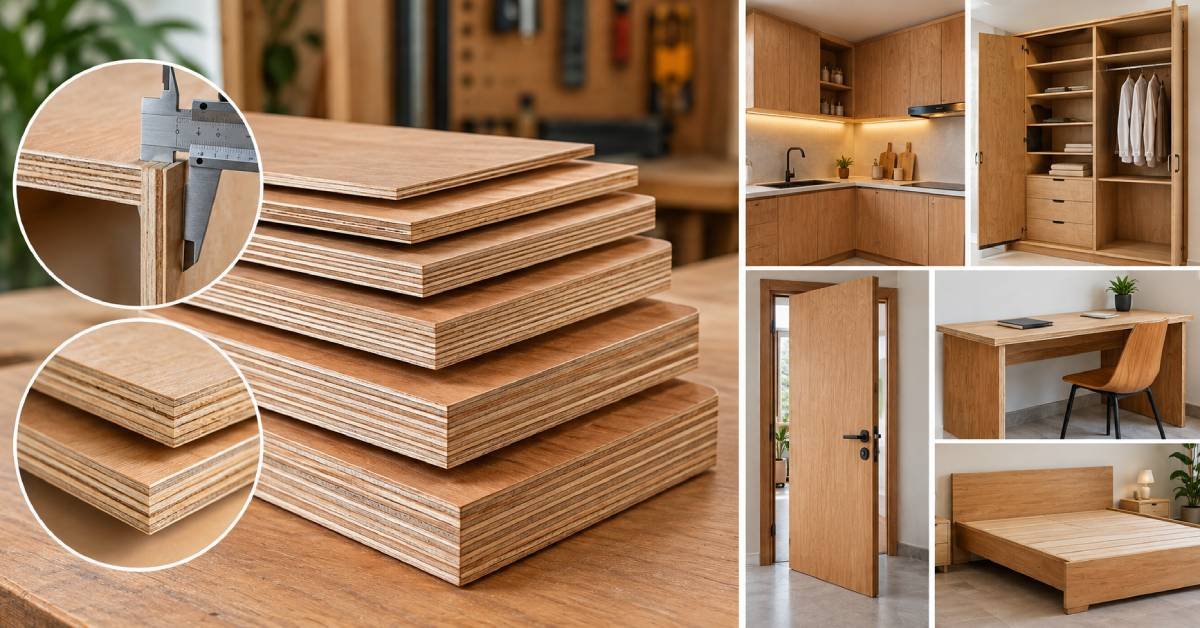
Suppose you're having a new wardrobe made but you don’t know what plywood thickness to go for. On the outside, all plywood might look the same. However, the plywood thickness determines so much more.
The strength, durability, weight, and cost. All change depending on this specification. This helps if you are planning to make a shelf, cabinet, wardrobe or internal structure.
Whether you are going to create furniture, cabinets, shelves or interiors, knowledge regarding plywood grades in thickness becomes quite handy.
Let’s see how a better choice of plywood thickness significantly changes not only its strength and sturdiness but also its weight and final price.
What Is Plywood Thickness?
Plywood thickness refers to how thick the plywood sheet is, usually measured in millimetres (mm) or inches.
When shopping for plywood, you may come across terms such as 6 mm, 9 mm, 12 mm, 16 mm, 18 mm and 25 mm. These are common options, although the exact range can vary between manufacturers and plywood types.
The Standard Plywood Sizes and Thickness
|
Plywood thickness |
Common uses |
|
3–4 mm |
Back panels, decorative work and lightweight applications |
|
6 mm |
Cabinet backs, drawer bottoms and light furniture components |
|
9 mm |
Small shelves, partitions and furniture components |
|
12 mm |
Cabinets, shelves and moderate-load applications |
|
16 mm |
Furniture, cabinets and some wardrobe components |
|
18 mm |
Wardrobes, beds, tables and heavy-duty furniture |
|
25 mm |
Heavy-duty shelves, worktops and applications needing extra strength |
Plywood Thickness in Inches
Plywood thickness is often discussed in millimetres, but you may also see it listed in inches.
Some common conversions are:
- 6 mm ≈ ¼ inch
- 9 mm ≈ ⅜ inch
- 12 mm ≈ ½ inch
- 16 mm ≈ ⅝ inch
- 18 mm ≈ ¾ inch
- 25 mm ≈ 1 inch
So, if someone asks for inch thick plywood, they are referring to plywood that is approximately 25 mm thick.
How to Choose the Right Plywood Thickness
It becomes a lot easier to decide on a specific plywood type if you're prepared to answer the following basic questions.
1. What is it that you're trying to build?
Always the first and easiest point of call. The performance requirements for a drawer-bottom differ greatly from those of a dining table or a wardrobe shelf.
Lightweight panels need only thin plywood whereas the strength needed in furniture designed to hold the weight of potentially large amounts of household items generally dictates thicker sheets.
2. How will it stand up to what load?
A bookcase requires stronger material and finer support than a decorative display shelf that can be sparsely loaded.
Where substantial weight is to be accommodated, thick panels and appropriate underlying supports are vital.
3. How large will it be if not supported in any way?
Another detail often overlooked. A short shelf with enough vertical or diagonal supports below it may need thinner panels than a long shelf that offers support only at its two extreme ends. Such a sheet needs to be thicker to retain structural rigidity without buckling.
4. How will it be presented and what sort of atmosphere are you intending to create?
No finishing will ever negate the need for a panel thick enough to do the job for which it has been made. Varnish, paint or laminations do little to strengthen the structural panel.
5. What does your furniture design require?
In some cases, the intended configuration determines plywood thickness: A minimalist cabinet could rely on finely planned supports beneath an already quite thin panel whereas conventional designs simply tolerate the extra thickness of a thick sheet to fulfil whatever need exists.
Perfect Plywood Thickness for Wardrobe
For homeowners, the frequent question asked is regarding the plywood thickness for wardrobe.
18 mm plywood for wardrobe frame construction is widely preferred because it offers a reasonable balance between strength to bear, stability and weight.
But not every part needs the same thickness.
For example:
- 18 mm: Commonly used for carcasses, shutters and shelves that need good strength.
- 12 mm: Can be suitable for certain internal components and lighter sections.
- 6–9 mm: Often used for back panels or other lightweight components, depending on the design.
Is Thicker Plywood Always Better?
No, but it seems obvious that the right plywood thickness equals good furniture, does it not? Too-thick plywood makes a project too heavy, too expensive, and unnecessarily more difficult to install.
You don't want to install 25mm plywood on all the components for a lightweight cabinet.
Similarly, too-thin plywood is going to sag if placed on a heavily loaded shelf. Instead: We want the right thickness plywood, not the thickest available plywood.
Plywood Standard Thickness mm: A Quick Reference
If you are comparing plywood options at a store, this quick reference can make the decision easier:
Light-duty work: 3–9 mm
General furniture and cabinets: 12–18 mm
Heavy-duty furniture: 18–25 mm
Keep in mind these are just guidelines. They don’t account for the grade of the plywood, the number of plywood or layers, the quality of the layers, the structural support system being implemented or the type of project.
Common Mistakes When Choosing Plywood Thickness
There are common mistakes people make when deciding on plywood thickness:
Choosing based only on price
The least expensive plywood sheet is rarely the strongest sheet that’s adequate for the job.
Using one thickness everywhere
A common mistake is using plywood for every job: not understanding that specific pieces of furniture have different needs.
Ignoring shelf span
A longer span of unsupported shelf often needs increased thickness and support.
Confusing size with thickness
A large sheet may be bigger, but it might also be thinner than a smaller sheet, thereby lacking support for the job it needs to perform.
Not checking specifications
Always verify with the manufacturer to check specifications and intended applications of the wood prior to purchase.
FAQs
Q1. How to choose plywood thickness?
It would vary depending on the application and the type of load or support it has to hold. For heavyweight furniture, generally very thick plywood is used, but for lightweight components, use a lightweight sheet-like one.
Q2. Which is the strongest plywood?
It would entirely depend on the type and the quality as well as the construction of the particular ply, but generally, for greater strength, take either structural-grade ply or marine ply.
Q3. What are the plywood sizes and thickness?
In terms of size typically 8x4 ft, but for different thicknesses, it varies from 3 mm to 25 mm depending on the brand.
Q4. What is the standard plywood thickness in mm?
Commonly available ply standard thickness mm choice includes 6, 9, 12, 16, 18 and 25 mm but it mainly depends on the product available and per brand you purchase.
Q5. What plywood thickness is best for a wardrobe?
18 mm ply is commonly utilised for structure, shelves, and also the shutter for the wardrobe. But for the bottom or some part not subject to a lot of load could even use 12 mm ply if that's desired for the back.
Conclusion
Deciding on plywood thickness doesn't have to seem overwhelming. Understanding plywood thickness in mm, how different plywood sizes relate to each other in terms of their thickness, and how thickness impacts the suitability for different furniture jobs makes the decision quite logical.
Begin with the intended job the plywood must perform. Next, analyze it's load, span, support, style, and budget.
It all boils down to the fact that, for every job, the best plywood is not the sheet with the greatest thickness hanging at the lumber yard, but rather the sheet with an adequate thickness.


