
Plywood Wooden Mandir Design for Home: Ideas, Types, Costs & Expert Tips
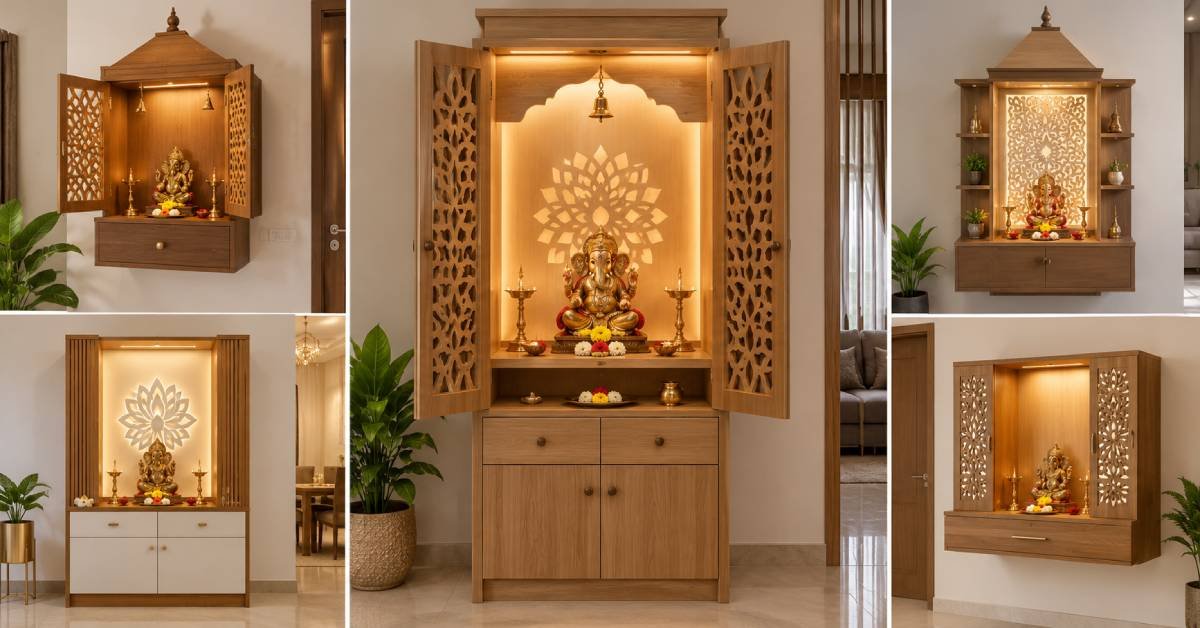
A dedicated plywood wooden mandir design for home can beautify your space. This is the ultimate place where you pray so it needs to be exactly perfect.
Whether it is in a small apartment or a spacious home, it is very important to plan a smart plywood door design for your home mandir and make an antique, spiritual and cosy addition to the space without giving more importance to the space constraints.
There are various ways and means in which plywood serves its use to the mandirs of home. Since plywood can be easily moulded, is lighter compared to wood and is easy to operate for customisation.
Let’s see what colours, laminations, and finishes you need to match your decor and interiors.
Ideas for Plywood Wooden Mandir Design for Home
1. Wall-Mounted Plywood Mandir
This type of mandir works best in a compact apartment or smaller apartment. Such a unit can have a raised platform with idols and a couple of shelves in addition to a decorative backing.
You could have the structure decorated with a temple-like arch or outlines to provide it with an auspicious look, and add warm illumination beneath the shelves to enhance the visual appeal.
This option is convenient and can effectively utilise a blank wall in the room while also leaving the floor below open, lending a more spacious feel to the room.
2. Plywood Mandir With Jaali Panels
While you may want a little traditional craftsmanship incorporated in the design of your mandir, the structure cannot become too intricate, adding more visual mass to your room. Plywood jaali work could make your mandir both functional and aesthetic.
A jaali panel could be placed behind the idols, and this would suit even more contemporary-designed homes when executed with a modern touch like geometric or linear patterns, and a slightly warm hue.
For homes where a classic touch is a must-have, a traditional floral or similar pattern could create that look while simultaneously providing a good passage for light to diffuse through to the idols while not being too opaque.
3. Plywood Mandir With Doors
A mandir with a plywood door design is ideally meant for you if you like to keep your pooja space out of sight when it is not in use. It may be a set of sliding or hinged doors. You can choose between solid wood, glass panel doors with carvings, or simply wooden slats, along with a decorative panel.
Custom-designed doors made of wood would truly make a significant difference here.
You may go in for CNC (Computer Numerical Control) cuts in attractive patterns, wood-looking plywood sheet design, or grooves and carving work.
4. Corner Plywood Mandir
If you happen to have an unused corner in your living space, then a triangular or an L-shaped plywood mandir would be the perfect solution. The mandir may have a small raised platform with a couple of shelves above it.
You could also have a small drawer included below to store things used in prayer such as prayer books, incense sticks, etc. These designs make effective use of space and can even include a compact decorative backdrop if desired.
5. Freestanding Plywood Mandir
If you have more flexible floor space and move furniture around frequently, a freestanding plywood mandir would be a smart choice.
It would be like a small wooden temple made of several panels with a roof-like covering and space inside for idols on a raised platform with several compartments and shelves.
These can even have decorative elements at the base to look more traditional. They do not need to be fixed to a wall at any time, making them readily mobile as well.
6. Modern Minimalist Plywood Mandir
Today, home interiors often focus on sleek lines and minimal adornment, and the plywood mandir can do no differently. You could simply use a clean, unfussy design, keeping in line with the simplicity required.
Minimal designs of plywood mandirs, in neutral colour laminates, or finished with a light woody finish, along with appropriate LED lighting, can blend seamlessly with modern interiors.
You could add details like simple groove carvings to give the design more definition, but no ornate details are recommended.
7. Plywood Mandir With Storage
Besides serving as a home to the idols and religious books, the plywood mandir can even be designed to incorporate ample storage space for items that you usually require.
There may be drawers beneath the main platform where you store your diyas, incense sticks, etc., closed cabinets, or simple, concealed shelves at the bottom so that nothing disrupts the sanctity of your pooja space or spoils its aesthetic appeal by making it look overcrowded or untidy.
Types of Plywood to Consider
MR Grade Plywood
Moisture-Resistant plywood is often made used for interior furniture. This may be appropriate for a mandir set-up in a dry indoor environment.
BWR Plywood
Boiling Water Resistant plywood would have more moisture resistivity over the MR Plywood. One may opt for this option if the pooja corner is located in a place where it might be humid sometimes.
BWP or Marine Plywood
This offers more moisture resistance, but it would be expensive. I don't feel that for ordinary interior mandirs this is necessarily essential unless justified by the site construction or placement factors.
Cost of Plywood Wooden Mandir Design For Home
|
Mandir Type |
Approximate Cost |
|
Small wall-mounted unit |
₹5,000–₹12,000 |
|
Basic compact pooja unit |
₹10,000–₹20,000 |
|
Medium customised mandir |
₹20,000–₹40,000 |
|
Detailed wooden-style mandir |
₹40,000–₹75,000+ |
|
Large customised unit with storage |
₹60,000–₹1 lakh+ |
Expert Tips for Plywood Wooden Mandir Design for Home
- Measure the space: Make sure your dimensions aren't so big that they consume and cram up the whole room, nor so small that they don't suffice for the required storage space.
- Plan ventilation: Give adequate space for ventilation around the mandir, especially if it's going to be used extensively for diyas and incense sticks.
- Incorporate lighting: Ensure electrical points are adequate and planned during this phase for warm LED lighting during evenings.
- Ensure usage of quality materials: Invest in good quality plywood, laminates, finishes and hardware to enhance durability.
- Ensure ease of cleaning: Keep the intricate designs to a bare minimum, as smoke and dust accumulation is to be a regular sight!
- Complement your interior: Choose a mandir that accentuates your interior design the most in terms of colour, shade, patterns and texture.
FAQs
Q1. Is plywood mandir good?
Yes, plywood has the benefit of being adaptable, as it can incorporate a range of different designs, finishes and features, such as additional shelving or decorative detail, meaning it would make an adaptable home mandir.
Q2. Which wood is best for mandir at home?
Teak, sheesham and oak are commonly used for wooden mandirs; the correct wood choice will, however, depend on budget, style considerations and the requirement to last.
Q3. What is the plywood wooden mandir price?
Depending on its style, a plywood wooden mandir could be priced anywhere between around ₹5,000 for small compact items to well over ₹100,000 for large-scale designs with many added embellishments.
Q4. What are some plywood wooden mandir design ideas?
Some common plywood wooden mandir design ideas include corner units, wall-mounted mandirs, mandirs with a number of doors or built into other parts of the house/room, open-plan mandirs and minimalist style units.
Q5. How do I choose the right plywood for a mandir?
You can judge which ply is suitable according to the place it will be located. Factors in favour of its use will also be the finish, thickness and quality of the plywood.
Conclusion
A well-conceived plywood wooden mandir design for home seamlessly integrates function, spirituality, and aesthetics. This requires designing and selecting a mandir that perfectly suits the area allotted, rather than a style purely for the look and feel of the architecture.
Begin by assessing the dimensions of your allocated space, whether it will be a wall-mounted, corner, freestanding or closed design. Then determine the type of plywood to be used and its finish.
Prior to considering adequate lighting, ventilation, space for idols, as well as storage. And lastly, ongoing maintenance before fabrication begins.
A cleverly selected, properly finished and proportioned plywood mandir can truly lend it space within any Indian home.
Learn More: Plywood Sheets: Understanding Different Types and Their Uses


