
Types of Countertops for Indian Homes: Materials, Designs and Benefits
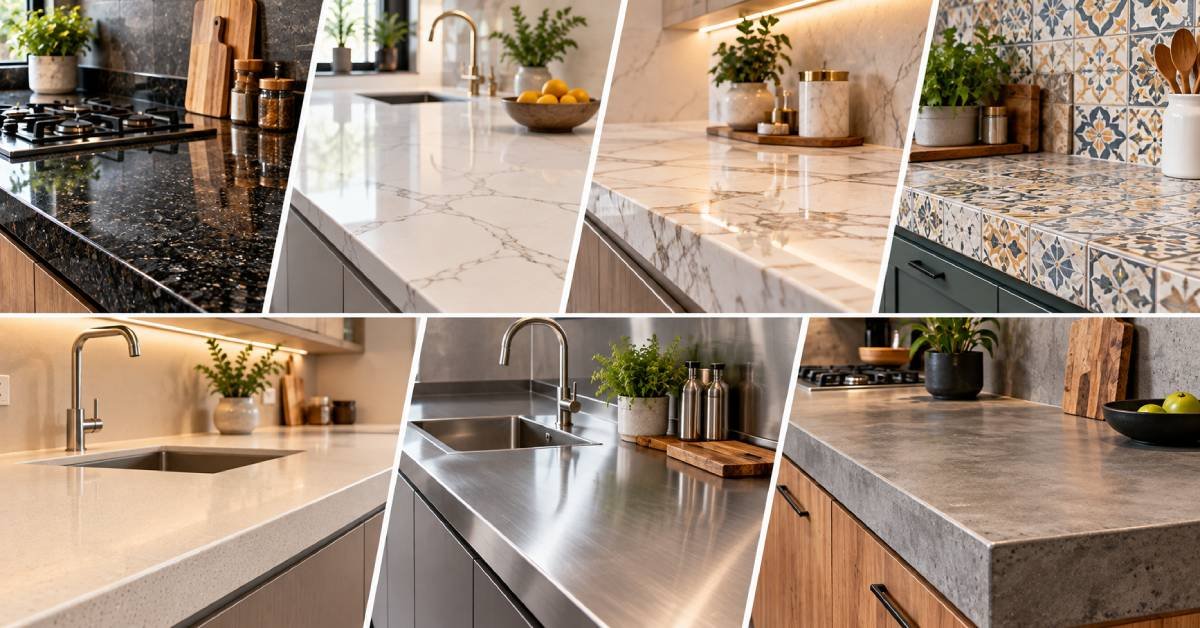
Granite, Quartz, Porcelain, Marble — there are many types of countertops to choose from. Imagine a regular chaotic weekday. As you rush, you've got a hot pan to set, vegetables to chop, and your cup of tea that seems to totter everywhere. Your kitchen counter has to do all the work. That's why settling for design when it comes to countertops is wrong.
Your right countertop should match your cooking style, be durable for every day usage, and also match your overall kitchen design. You have several types of kitchen countertops in the market with the most economical Tiles.
Read further to find out about kitchen counter top materials, their pros, cons, styles and dimensions.
Types of Countertops for Indian Kitchens
These are the most reliable types of kitchen countertops choices for your home.
1. Granite Countertops
Granite is one of the best kitchen countertops options in India. Being naturally strong and heat resistant along with alluring patterns, makes this an ideal option for daily cooking kitchens.
Benefits:
- Handles everyday kitchen use and heat well.
- Offers excellent durability when properly maintained.
- Available in a selection of colours such as black, brown, grey and white.
- Provides good value over the long term.
Black granite is a staple of traditional Indian kitchens, while more delicate hues are more appropriate in modern kitchens. A polished finish creates a glossiness while a leathered finish provides a rough surface.
For households looking for a practical, resilient kitchen work surface material capable of withstanding anything you can throw at it.
2. Quartz Countertops
If you want to save time on sealing but desire a blank, same-faced kitchen style, then quartz might be one of the fitting kitchen countertop materials for you. Engineered quartz is made with pulverised quartz particles, resins and colour pigments, hence the same pattern and colour throughout. Explore different quartz countertops to find designs that complement your kitchen interiors.
Benefits:
- Non-porous surface that resists everyday staining.
- Generally does not require periodic sealing.
- Available in consistent colours and marble-inspired designs.
- Easy to clean with mild household cleaners.
White quartz with faint grey veining looks great with contemporary kitchens. Beige, charcoal and solid coloured options are ideal for a minimal style.
Using very hot pots and pans can scorch quartz, which isn't as heat resistant as granite, so always employ trivets. Also, different products have different levels of quality and resin.
Those who love a sleek, contemporary style, uniform designs and super easy to care for.
3. Marble Countertops
Marble is one of those types of countertops that adds sophistication to a kitchen unlike many others. The subtle veining and soft colour variations make it ideal for high-end kitchens.
Benefits:
- Offers a luxurious, natural appearance.
- Each slab has unique patterns.
- Great for traditional, modern and premium interiors.
- Can complement matching marble backsplashes and islands.
While classic white marble with grey veins always looks fresh, warmer beige or darker shades can add richness and warmth to your scheme.
Marble is a soft stone and is prone to scratching as well as etching and staining from acids such as lemon juice and vinegar. It requires some maintenance and frequent sealing.
Homeowners who love the look of the surface and want to spend some time maintaining the concrete.
4. Ceramic and Vitrified Tile Countertops
These kitchen top materials come in many colours, textures, patterns and sizes, giving you greater leeway in designing a platform for your cooking area. They are also the best fit for classic as well as modern homes.
Benefits:
- Available across a wide range of budgets.
- Resistant to heat under normal kitchen conditions.
- Offers extensive design possibilities.
- Remove one cracked tile without removing the whole countertop.
Large sized tiles help create a more sleek and modern appearance. Patterned ceramic tiles work wonders for traditional and eclectic kitchens.
The grout lines tend to trap grease, grime and water. Make sure the tiled edge and grout joint areas are sealed to avoid chipping and dampness.
Favourable to the cost-sensitive individual who enjoys a flexible type of design, as well as possesses the time to tidy and preserve the joints.
5. Solid Surface Countertops
The majority of solid surface countertops use manufactured substances, often acrylic-based materials with added mineral components. They're a common choice of contemporary kitchen platform material because joints can be minimised and the finish can be smooth and uniform.
Benefits:
- Creates a smooth, uniform appearance.
- Offers a variety of colours and finishes.
- Non-porous varieties are easy to clean.
- Superficial scratches can be fixed but only for certain products.
Neutral shades of white, beige and grey work best in minimalist settings. You can integrate sinks with many of our compatible systems. Solid surfaces are not as resistant to heat and scratching.
6. Stainless Steel Countertops
Stainless steel countertops are among the top types of countertops you’ll see featured in professional kitchens in particular. The reasons for this are the easy-to-clean surfaces that are still practical and work well in a residential kitchen.
Benefits:
- Non-porous and easy to sanitise.
- Handles heat well.
- Does not require sealing.
- Offers a clean, functional appearance.
Brushed stainless steel is also great if you're into an industrial-style kitchen and looks great with minimalist cabinetry, open shelving and metallic hardware.
Fingerprints and watermarks are more likely to be visible on stainless steel, and scratches and dents may show up on it.
7. Concrete Countertops
The best kitchen countertop material with unique features, concrete can also be cast and shaped to fit precise dimensions. Some manufacturers will even make integrated features within the form.
Benefits:
- Offers considerable customisation.
- Creates a bold, industrial-inspired look.
- Available in various textures and colours.
- Can be used on wood, linear cupboards and metals.
Use grey concrete for more industrial surroundings or colour matched finishes for modern spaces.
Very heavy. Will require special supports and reinforcements. Prone to cracking and staining. Can require professional fabrication.
Kitchens that look special so you don't have to clean away fingerprint grease so much.
How to Choose the Best Types of Kitchen Countertops
With so many types of countertops out there, the right one for you will really depend on how you use your kitchen.
| Your Priority | Material to Consider |
|---|---|
| Everyday Indian cooking | Granite |
| Low-maintenance modern design | Quartz |
| Luxury and natural patterns | Marble |
| Budget and design flexibility | Ceramic or vitrified tiles |
| Seamless contemporary finish | Solid surface |
| Hygiene and functionality | Stainless steel |
| Custom industrial aesthetic | Concrete |
FAQs
Q1. Which are the best kitchen countertops for Indian homes?
Granite is best for durability and heat resistance and Quartz is best for uniformity and low maintenance.
Q2. Which kitchen countertop material is easiest to maintain?
Porous quartz and solid surface tend to be effortless to wash and do not demand regular sealing.
Q3. Is granite better than quartz for Indian cooking?
Granite can usually stand up to direct heat better, and quartz provides a more uniform appearance and easier ordinary upkeep.
Q4. Which kitchen platform material is best on a budget?
Granite, ceramic or vitrified tiles are cost effective materials, depending on grade, design and installation costs. Always compare full installed prices.
Q5. Can marble be used for kitchen countertops?
Yes, although it requires more maintenance than granite or quartz due to the staining, scratching and reactivity to acidic ingredients. It is suitable for those homeowners who place a high value on appearance and are happy to meet the maintenance demands.
Conclusion
Ultimately, your decision will come down to durability and appearance, as well as how much effort you're willing to put into cleaning, and your budget. If you have a high-traffic family kitchen, then granite is probably your best bet. Meanwhile, quartz can be a better fit if you're renovating a modern space.
Look around before you purchase. Ask for full size samples, compare installed costs and find out how well the material can be sealed, heat resistant and repaired. There are many types of countertops and the best one isn't necessarily the costliest or most trendy. It's the one that keeps doing its job for your family long after the remodel.


