
Veneer vs Laminate: Differences, Pros, Cons, Cost & Buying Guide (2026)
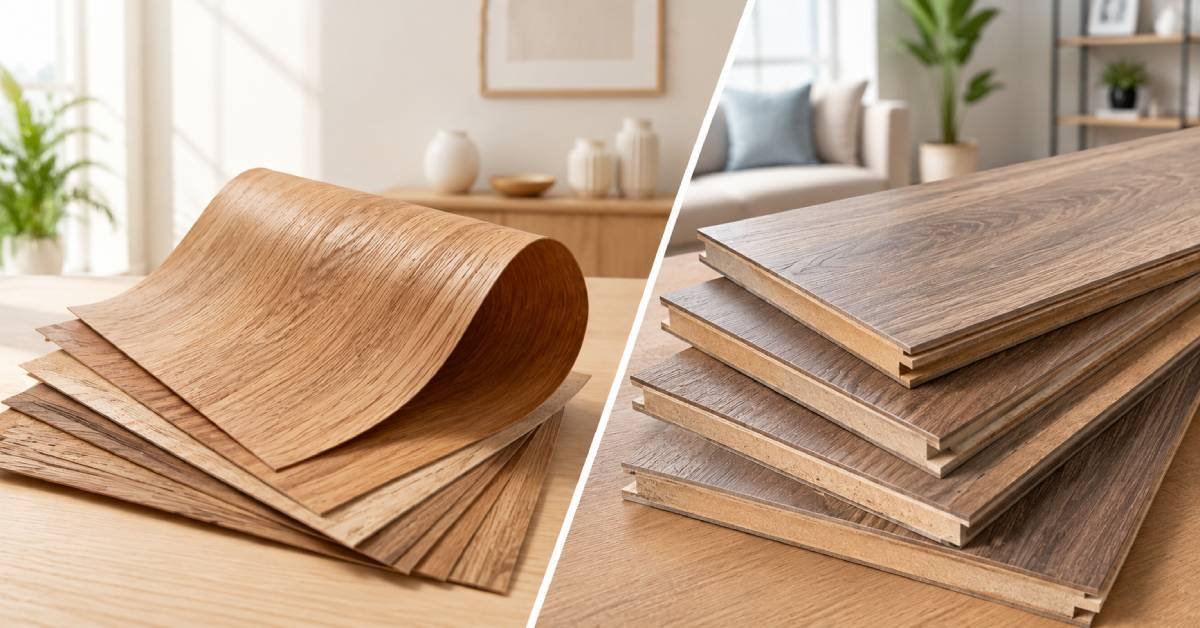
Veneer vs laminate has been a long standing debate. They are both quite similar visually and as you can see one has natural veneer and other having the laminate with uniform and smooth wood grains.
They are both utilized to finish plywood, MDF, wall paneling and interior surfaces, and furniture but vary significantly in aesthetics, robustness, maintenance, expenditure, and the applications that can be used.
The looks of both of them are very attractive. But which one should you be choosing?
If you are planning a house renovation in the year 2026 then this guide will surely help you know about veneer sheets vs laminate, pros and cons, cost and many factors you must consider before you purchase.
What Is Veneer?
Wood veneer is very simply a thin piece of genuine wood obtained from peeling an entire log of actual wood.
Natural wood veneer will inevitably differ in colour, the pattern it may display when viewed from a particular angle (grain) and in terms of overall character as each sheet represents that from a different piece of the log.
Common choices such as teak, oak, walnut or ash veneer will differ again from one another.
For example, although two wardrobe shutters may have the same colour by using walnut veneer, it is highly unlikely the exact grain on each shutter will be exactly the same as on the other, which is part of what makes wood veneer so appealing to some.
Typically wood veneer sheets are glued onto a rigid base that may be MDF, and thereafter lacquered, stained, or finished in an appropriate way.
Pros of Veneer
- Offers the authentic appearance and texture of natural wood.
- Every surface has a unique grain pattern.
- Can be stained or polished in different shades.
- Creates a warm, premium and sophisticated look.
- Can be sanded and refinished in some applications.
- Uses a thin layer of real timber rather than solid wood throughout.
Cons of Veneer
- Usually requires more care than laminate.
- Can be affected by moisture if poorly finished or maintained.
- Natural colour and grain variations may make matching difficult.
- Scratches and stains may require refinishing rather than simple replacement.
- Premium wood species can make the overall finish relatively expensive.
What Is Laminate?
Laminate as manufacturing process for decorative surfaces that uses a press to apply various types papers and resin at the surface that used as decor, for more simply, used as a type that that could imitation with, that you want so what do you want, wood, stone and that one that that you like.
The top layer of laminate bears a color, pattern, or texture, for instance: matte wood grains to high-gloss surfaces, textured finishes and anti-fingerprint options.
At present, laminate sheets are commonly available in a wide variety of colors and textures, for almost any design you want for room design.
For instance, in the case of a white closet you designed, a light woodgrain pattern in the top layer and is not required for some species of timber to replicate that look.
A laminate can also help you attain that look on many shutters at a time.
Pros of Laminate
- Available in a wide variety of colours, patterns and textures.
- They will typically be straightforward to clean and maintain.
- Excellent resistance to daily scratches and wear (subject to grade).
- No color-to-color variation if many pieces are required.
- They are generally more economical than high-quality natural timber finishes.
- Ideal for kitchens, wardrobes, cabinetry, and tv units and furniture.
Cons of Laminate
- Does not provide the authentic depth and variation of natural wood.
- Damaged laminate typically requires replacement, as it’s hard to refinish
- Improper installation may result in issues such as bubbling, lifting or exposed joints
- Highly polished surfaces are prone to show fingerprints and scratches
- Specialty, higher-quality laminates may be prohibitively costly compared to standard varieties
Veneer Sheet vs Laminate: Key Differences
Let’s break down and compare veneer sheet vs laminate. At their core, laminates and veneer are entirely different. Laminates are man-made decorative surface material while veneers are natural, real wood.
|
Feature |
Veneer |
Laminate |
|
Material |
Thin natural wood |
Manufactured paper/resin surface |
|
Appearance |
Natural and unique |
Consistent and highly varied |
|
Grain |
Genuine wood grain |
Printed/reproduced grain |
|
Maintenance |
Moderate |
Generally easy |
|
Design choices |
Depends on wood species |
Extremely extensive |
|
Repair |
Can sometimes be sanded/refinished |
Usually replaced if badly damaged |
|
Moisture resistance |
Depends heavily on finish |
Generally better for everyday use |
|
Cost |
Moderate to premium |
Budget to premium |
|
Best for |
Warm, natural interiors |
Practical, durable interiors |
Veneer vs Laminate: Which Is More Durable?
Suppose you are choosing a finish for a wardrobe in a bedroom. It may experience relatively light daily wear. Veneer could work beautifully because its natural appearance becomes a major design feature.
Now consider a busy kitchen where cabinet shutters are opened repeatedly, exposed to food stains and cleaned frequently. A good quality laminate could be quite a practical option here, however.
The finish will remain good for years if a good quality material with suitable substrate is chosen and installed and cared for properly, although many good laminates cope with heavy domestic wear very well anyway and a well finished veneer can also remain visually pleasing for many years.
It is just crucial to choose the finish required to match the task rather than purely the appearance.
Where Should You Use Veneer?
Veneer works especially well when the design calls for warmth and natural character.
Consider using veneer for:
- Bedroom wardrobes
- Premium TV units
- Feature furniture
- Study tables
- Designer cabinets
- Decorative wall panels
- Headboards
- Living-room furniture
Wall laminate sheets can also be used for feature walls, but if your goal is to create the visual warmth of genuine timber, veneer may offer a more natural result.
Where Should You Use Laminate?
Laminate is particularly useful when practicality, design flexibility and easy maintenance are priorities.
Common applications include:
- Kitchen cabinets
- Wardrobes
- Storage units
- Study furniture
- TV units
- Office furniture
- Doors
- Wall panels
- Commercial interiors
Decorative laminate is also useful when you want to repeat the same colour or pattern across several pieces of furniture.
Veneer vs Laminate: Cost in 2026
Cost is one of the most important considerations when comparing laminates and veneers.
In India, laminate pricing varies significantly by thickness, finish, brand and application. Current 2026 market guides put many standard decorative laminates roughly in the range of ₹30–₹150+ per sq. ft., while premium textured, acrylic and speciality options can cost substantially more.
Natural veneer prices also vary widely depending on the wood species, grain, thickness and finish. A 2026 Indian veneer price guide places broad veneer pricing around ₹45–₹350+ per sq. ft., with premium species such as teak and walnut occupying higher ranges.
However, material price is only one part of the calculation. Veneer generally requires adhesive, polishing or finishing work, while laminate requires careful pasting and edge finishing. Labour, wastage, substrate and installation can therefore change the final project cost.
So, when comparing quotations, do not compare only the price of the sheet. Ask for the complete finished-surface cost.
FAQs
1. Which is best, veneer or laminate?
Veneer offers genuine wood and a natural appearance, while laminate generally provides greater design variety and easier maintenance. The better option depends on the application and your priorities.
2. Are veneer sheets more expensive than laminate sheets?
They can be, particularly when premium wood species and polishing are involved. However, prices vary considerably by material, brand, finish and installation requirements.
3. Can laminate look like real wood?
Yes. Decorative laminate is capable of replicating wood grains, colors and textures quite accurately. It will not, however, possess the natural variation present in genuine veneer.
4. Are wall laminate sheets suitable for home interiors?
Yes. Laminate is perfectly suitable for a variety of decorative wall panels and furniture surfaces when the appropriate product is utilized. Always refer to the manufacturer's application recommendations.
5. Which is easier to maintain, veneer or laminate?
Laminate typically involves much less upkeep for standard household wear and tear. While veneers can be very durable, the inherent nature of real wood on the surface typically involves greater care for cleaning and finishes.
Conclusion
So, veneer vs laminate which is the better decision? Neither is a clear-cut winner!
Go with veneer if the appeal of real wood, nature’s inherent imperfections, unique grains, the luxurious look and feel of wood furniture are most important.
Go with laminate if visual range, minimal upkeep, and practical durability make this furniture finish option the clear preference.
Ultimately the best fit depends on room conditions, how much wear and tear an item receives, your personal commitment to care and your spending limit.
Instead of asking yourself which finish is best, try asking this helpful question: “Which furniture finish will work best where I live?” Your decision becomes much simpler when you reframe the question this way.


